What Is Colloidal Silica and How Does It Work in Concrete?
Colloidal silica is increasingly being used in concrete to influence fresh and hardened properties, but understanding what it is and how it behaves is essential to using it effectively.
Unlike larger silica-based materials, colloidal silica consists of extremely small, discrete silica particles suspended in a liquid. Their size, surface area, concentration, and surface chemistry influence how they interact within a concrete mixture.
Understanding those fundamentals is the first step toward understanding where colloidal silica can provide value and how it should be evaluated for a specific application.
What Is Colloidal Silica?
Colloidal silica is a stable dispersion of very small, nonporous particles of silicon dioxide (SiO₂) in a liquid, typically water. Rather than being dissolved in the liquid, the silica exists as discrete particles distributed throughout the suspension.
These particles are extremely small, commonly measured in nanometers. Because of their small size, colloidal silica particles can have a very high specific surface area compared with larger silica materials.
That combination of particle size and surface area is important. It influences how colloidal silica behaves in cementitious systems and helps explain why two colloidal silica products with different particle characteristics may not behave identically in concrete.
WHY PARTICLE SIZE MATTERS
Particle size is one of the defining characteristics of colloidal silica. Because the particles are extremely small, a relatively small amount of material can provide a large amount of reactive surface area.
In cementitious systems, that surface area creates opportunities for interaction with the products of cement hydration. Colloidal silica can provide nucleation sites that influence hydration and can react with calcium hydroxide through pozzolanic reactions, contributing to additional calcium silicate hydrate (C-S-H).
Particle size also influences how a colloidal silica product behaves in a mixture. Smaller particles generally provide greater surface area, but greater surface area can also affect water demand, rheology, admixture interactions, and dosage requirements.
This is why “colloidal silica” should not be treated as a single, interchangeable material. Particle characteristics matter, and product selection should be based on the intended application and performance objective.
COLLOIDAL SILICA VS. SILICA FUME
Colloidal silica and silica fume are both silica-based materials used in concrete, but they are not the same material and should not be expected to behave the same way.
One of the most important differences is particle form and scale. Colloidal silica consists of discrete nanoscale silica particles dispersed in a liquid, while silica fume is a very fine powder composed primarily of amorphous silicon dioxide and is typically supplied as a dry or densified material, or as a slurry.
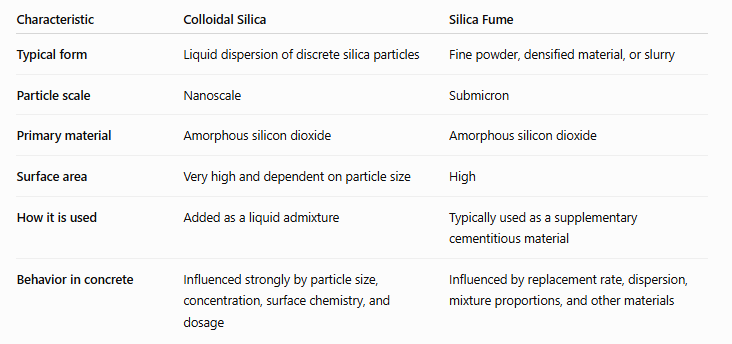
Both materials can influence hydration, pore structure, permeability, and other concrete properties, but they should not be treated as interchangeable sources of silica. Their physical characteristics, delivery methods, dosages, and interactions within a concrete mixture are different.